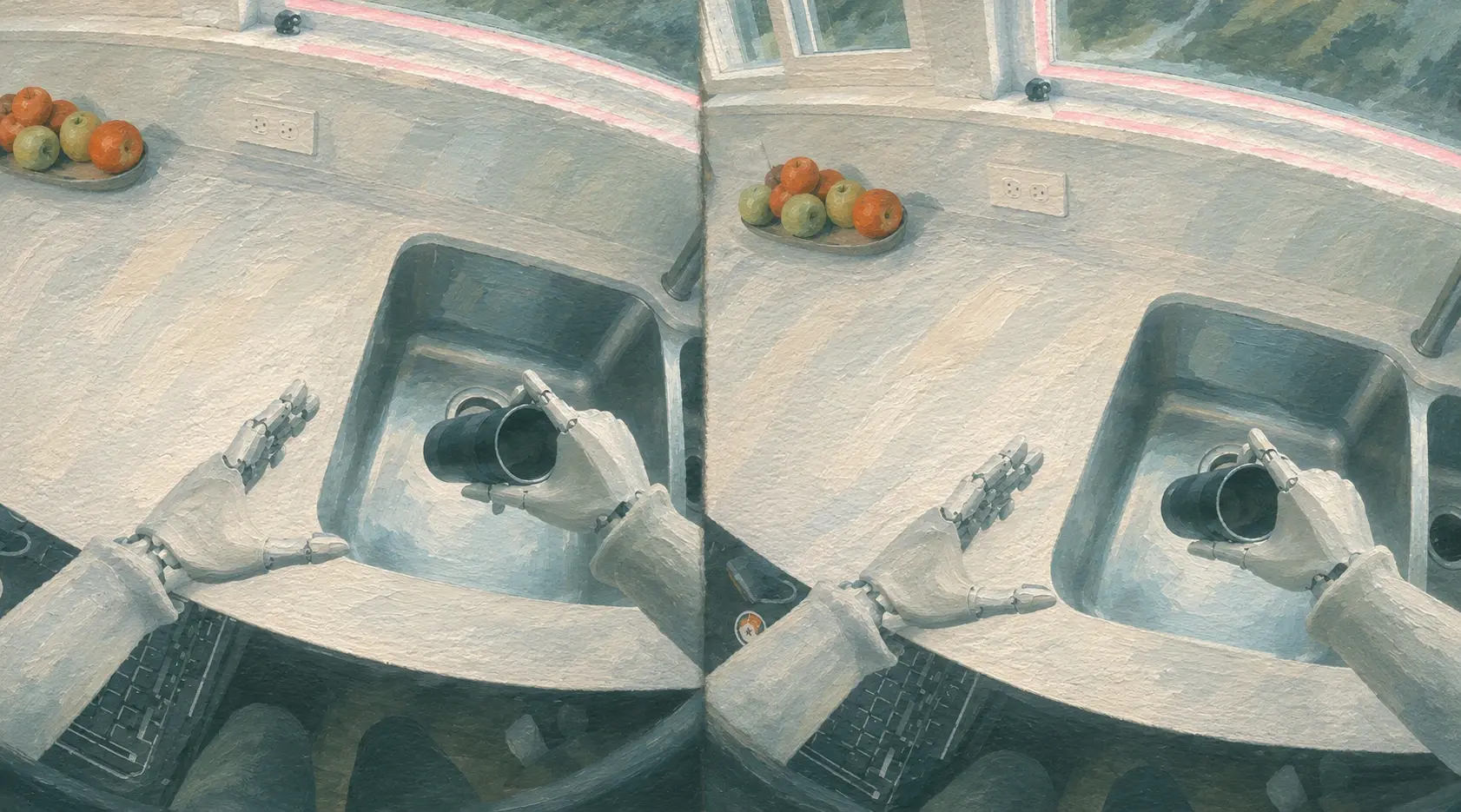


A teleoperation recording passes through several systems before it can support a training or evaluation decision. Each handoff needs to preserve what the signals mean, how they were aligned, which judgments were added and which version was tested.
A shared spatial representation can help teams inspect that chain. It does not make missing observations known or turn a recording into a physics simulator. The useful goal is a traceable path from a demonstration to a reviewed release and a defined evaluation.
This walkthrough uses a hypothetical pick-and-place session. It describes checks to agree for a program, not a claim that every capture mode, reconstruction or evaluation method is available through Avala.
Capture the signals the policy needs
Start with the distinction between what an operator commands and what the robot measures. A target joint position, an encoder reading and a pose estimated from video describe different things. Record their names, units, coordinate frames and timing conventions separately. If a channel was not captured, keep it missing rather than filling it with a plausible value.
Choose the control interface for the robot and task. A matching leader arm and a Cartesian controller make different tradeoffs. Neither choice guarantees clean demonstrations. Inspect command discontinuities, saturation, latency, interventions and measured response on representative recordings before scaling collection.
For the hypothetical pick, a capture contract might require camera observations, commanded actions, measured state, gripper signals and the control source. Those are requirements to verify, not fields to infer from a video of a moving robot. Record outcomes and recovery attempts alongside technical validity: a failed grasp can be useful evidence even when the recording itself is sound.
Describe the clock used by each stream. ROS distinguishes system, steady and ROS time; simulated time can pause or jump. Its clock design explains why playback and synchronization require explicit handling. A timestamp column alone does not establish that a camera exposure and a control command refer to the same instant.
Establish acceptable alignment error for the task and measure it. Prefer reliable timing at capture, and retain the method and residual uncertainty when correcting offsets later. There is no universal tolerance that makes every contact event trustworthy.
Keep observations and estimates distinguishable
Calibration and reconstruction can bring observations into a shared coordinate system. In this context, 4D means spatial information across time. That can make object motion, sensor disagreement and annotation review easier to inspect.
A reconstructed surface is still an estimate. Occluded regions, reflective materials, motion and incomplete sensor coverage can leave gaps. A rendered novel view is generated from the representation; it is not a camera observation that was secretly captured. Preserve the original recordings and the versions of calibration, transforms and reconstruction used to derive an artifact.
Before accepting the representation, compare it with relevant reference measurements and review difficult cases. Record what could not be resolved. A convincing rendering is useful for inspection, but its appearance does not certify geometry or physical dynamics.
Project labels, then review their limits
An object track in a shared frame can support projections into several camera views. That reduces repeated annotation work where calibration, geometry and visibility are adequate. It does not remove the need to update moving geometry, review identity through occlusion or check image-space boundaries.
For the box being picked, distinguish its observed extent, estimated geometry and human-assigned class. Contact timing, task phase and outcome may require their own evidence and review. Do not turn inferred intent or estimated weight into a measured field.
A review should ask whether the projection fits each supported view, whether the track stays with the same object, and whether uncertain intervals remain marked. Consistent projections can consistently propagate an upstream error. Agreement across frames is not sufficient evidence of correctness.
Test the output contract before a larger release
A reusable representation can support several exports, but each destination still needs a defined mapping. Specify fields, shapes, units, frames, timestamp conventions, episode boundaries, label definitions and missing-value behavior. Changing the representation does not automatically make every downstream format equivalent.
LeRobotDataset v3 documentation describes a format combining tabular signals, video and metadata. Its examples distinguish observation state from action fields. This is a useful reference for a handoff specification, not evidence that an arbitrary recording contains those signals or that a particular Avala conversion has passed a loader test.
Validate a representative export with the declared library version. Compare the loaded signals with the source, including a missing channel and an episode boundary. If a new label definition or target modality needs additional evidence, budget for that work. A format conversion cannot recover an unrecorded measurement.
Separate playback, simulation and physical evaluation
These methods answer different questions:
| Method | What it can help examine | What it does not establish alone |
|---|---|---|
| Recorded playback | What the system observed and predicted on a fixed recording | How the world would respond to a different action |
| Closed-loop simulation | Behavior under a specified dynamics, contact and sensor model | Equivalent performance on physical hardware |
| Physical evaluation | Outcomes on the tested robot and conditions | Generalization to every deployment condition |
A visual reconstruction is not, by itself, a validated dynamics model. MuJoCo's computation documentation describes contact-model assumptions and approximations. A simulated interaction therefore needs its own model and validation, even when its scene looks like a real recording.
For a repeatable evaluation, pin the inputs, processing versions, policy, configuration and relevant randomness. Check repeatability rather than assuming it from the presence of a world model. Keep training and held-out evaluation separated along the relevant leakage boundaries, such as environment or object identity.
Report the tested population, outcome definitions, denominator and known limits. Using the same representation can improve traceability; it does not prove that a score change came from the policy rather than a changed evaluation setup.
Use failures to plan the next collection
A failure becomes actionable when it can be located and examined. Link the evaluation result to the policy version, episode, input release and review decision. Separate a suspected model limitation from a capture defect or an incorrect label before commissioning more data.
If the pick fails under a particular occlusion, define the missing condition and an evaluation that could test the proposed improvement. Collect and review the relevant examples, then compare the next policy under a controlled protocol. Keep evaluation-only material out of the training release.
This loop does not require every tool to share one internal format. It requires clear interfaces and enough lineage to explain the result. A sequence identifier makes an investigation possible; it does not prove which training example caused a behavior.
Make each handoff inspectable
The practical starting point is a representative recording and an output contract. Establish which signals exist, which transformations are supported, what review accepts and how the result will be loaded or evaluated. Expand only after those checks answer the program's actual question.
Avala's role is to help teams connect data collection, labeling, review and delivery around that learning objective. Explore the robotics workflow, review the labeling capability reference, or book a working session to scope the handoff your team needs.