

In 2023, manufacturers installed 542,000 industrial robots worldwide, more than double the 221,000 units of a decade earlier. The market hit $16.7 billion, an all-time high, and by the end of 2026 the cumulative installed base will exceed 5.5 million machines running continuously across every manufacturing vertical. Every one of them generates data: sensor streams, joint states, camera feeds, error logs, performance metrics. Less than 1% of it is ever analyzed. Most is simply deleted.
We believe that deletion is the most consequential infrastructure failure in robotics, because the binding constraint on Physical AI is no longer algorithms or compute. It is data. The world's industrial robots are the largest potential fleet for collecting real-world manipulation data, and almost none of it reaches a training pipeline, because the layer to capture, standardize, and annotate it was never built. The companies that build that layer will control the data supply chain for Physical AI, and their advantage will compound the way Tesla's fleet data did in autonomous driving.
The fleet could produce 7.6 exabytes a year and keeps almost none
A typical six-axis robot running its control loop at 1 kHz generates roughly 124 kilobytes per second of core kinematic data: joint positions, velocities, torques, and tool-center-point poses. That is about 7 GB per day at full logging resolution. Add vibration monitoring at 5 kHz and it is 9–10 GB. Attach a vision system, increasingly standard for quality inspection, and the figure jumps to 10–120 GB per day. A mobile robot with LiDAR can hit 50 GB per hour. Even with conservative assumptions about fleet composition, the world's industrial robots could produce roughly 7.6 exabytes per year if fully instrumented.
Almost none of it survives. Most factories log at 1–10 Hz, summaries of cycle starts, completions, part counts, and alarms, perhaps 72 MB per robot per day. The control loop runs at 1–10 kHz, but only 0.1–1% of that data is typically logged in production. The high-fidelity torque curves, vibration signatures, and motion trajectories that would enable genuine machine learning are consumed in real time by servo controllers and overwritten every cycle. Long-term storage runs an estimated 1–10% of the theoretical volume; the share analyzed is far smaller.
Robotics is the extreme case of an industrial norm. IBM reports that 90% of data generated by industrial sensors never gets used. Forrester puts the figure at less than 1% of organizational data ever being analyzed.
Deletion is structural, not accidental
On-premise storage is expensive. Shop-floor bandwidth is limited: many factories still lack reliable wireless connectivity, and sending gigabyte-scale streams to the cloud is impractical. Legacy controllers have minimal onboard memory. Most important, manufacturers historically viewed robot data as operationally perishable: IBM notes that roughly 60% of industrial data loses its perceived value immediately. Without infrastructure to capture, contextualize, and store the data at scale, it simply evaporates.
The gap between aspiration and execution is enormous. PwC found that 91% of industrial companies are investing in digital factories while only 6% consider themselves fully digitized. The National Association of Manufacturers reports 70% still rely on manual data collection.
Four proprietary kingdoms, no common language
The data that does get captured hits a second wall: it is trapped in incompatible silos. Four ecosystems dominate industrial robotics (FANUC, ABB, KUKA, and Yaskawa), each with its own proprietary programming language, data protocol, and controller architecture: FANUC's TP and KAREL with the proprietary FOCAS protocol, ABB's RAPID with orientation stored as quaternions through RobotStudio, KUKA's KRL with the Robot Sensor Interface at 4–12 ms cycles, and Yaskawa's INFORM with the MotoCom API. These are not minor syntax differences. They are fundamentally incompatible data models, naming conventions, and I/O philosophies. Unlike CNC machining, where G-code provides a universal instruction set, no universal robot programming language exists.
The fragmentation is self-reinforcing. Manufacturers segment features behind paid options (FANUC charges separately for KAREL programming and ASCII upload), and machines that run reliably for 15–20 years make backward compatibility a brake on any new data architecture. A factory running FANUC in one cell and KUKA in another cannot pool operational data without custom middleware. A manufacturer with 30 plants across three continents has 30 data islands, even on a single robot brand, because no standard mechanism for cross-site sharing exists. Cross-fleet benchmarking, comparing identical robots doing similar tasks across facilities, is virtually impossible.
Flying blind already costs $1.4 trillion a year
Siemens' 2024 "True Cost of Downtime" report found that the world's 500 largest companies lose $1.4 trillion annually to unplanned downtime, 11% of their revenues, up from $864 billion a few years earlier. In automotive manufacturing, the most robot-intensive sector, unplanned downtime costs $2.3 million per hour, and the average large plant loses 27 hours per month.
Where robot data is actually used, the returns are outsized. Predictive maintenance can cut unplanned downtime by 30–50% and deliver 10:1 to 30:1 ROI within 12–18 months. FANUC's ZDT system has detected several hundred issues before they impacted production across 21,000+ connected robots. General Motors reportedly cut unplanned downtime by 15% and saved $20 million annually through robot monitoring.
These are exceptions. McKinsey's survey of 800+ manufacturers found 74% stuck in "pilot purgatory," running isolated digital initiatives that never scale to enterprise-wide impact; only about 30% capture value from Industry 4.0 at scale. The bottleneck is not algorithms or computing power. It is the ability to reliably capture, standardize, store, and serve manufacturing data across diverse equipment, sites, and time horizons.
Physical AI needs exactly the data factories delete
The field has converged on vision-language-action (VLA) architectures, and the strongest results come from data diversity. Google DeepMind's RT-2 fine-tunes 55-billion-parameter vision-language models on robot trajectory data. The Open X-Embodiment project, a collaboration of 21 institutions, assembled over 1 million real robot trajectories from 22 robot types across 160,000+ tasks, and models trained on that cross-embodiment dataset showed a 50% improvement over those trained on individual datasets. Cross-robot data sharing demonstrably works.
The volumes are nowhere near enough. Tesla's FSD system trains on data from over 6 million vehicles driving billions of miles. NVIDIA's Cosmos world foundation models were trained on 20 million hours of video. The largest open-source real robot dataset holds roughly 1 million trajectories. The gap between available robotics data and what general-purpose embodied AI requires is orders of magnitude.
Meanwhile, the 4.66 million industrial robots in operation perform welding, assembly, painting, inspection, and material handling, every day, across every vertical. In principle, they are to Physical AI what Tesla's vehicle fleet is to autonomous driving: a distributed sensor network generating exactly the interaction data foundation models need. In practice, the fleet is dark to AI researchers, locked behind proprietary protocols and discarded at the edge.
The market has priced this in once already. Amazon's $380 million acqui-hire of Covariant's AI team, which built foundation models from data collected across warehouse robots worldwide, shows where the value is concentrating: Amazon now combines Covariant's models with data from its 750,000+ warehouse robots. That flywheel (more data, better models, more capable robots, more deployments, more data) is the same dynamic that made Tesla's FSD program nearly impossible to replicate.
Humanoids widen the gap by orders of magnitude
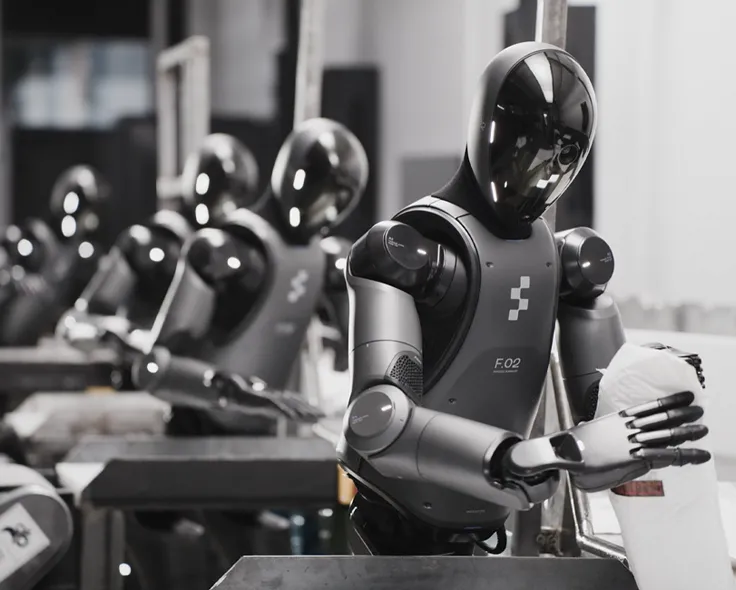
A six-axis arm has 6 degrees of freedom and minimal onboard sensing. Tesla's Optimus Gen 3 has 72+ degrees of freedom (28 in the body plus 22 per hand), along with cameras, IMUs, force-torque sensors at every joint, and tactile arrays. Figure 02 has 16 DoF per hand alone. Each additional degree of freedom multiplies the dimensionality of the data stream; a humanoid with a full sensory suite could generate gigabytes per hour.
This is not hypothetical. BMW is testing Figure 02 at its Spartanburg plant, Mercedes-Benz is piloting Apptronik's Apollo, and UBTech is deploying batches of 20 humanoids at Dongfeng Liuzhou Motor. Goldman Sachs projects the humanoid market at $38 billion by 2035; Yole Group forecasts 2+ million shipments per year by then. If even 1 million active humanoids each generate 10 GB per day, that is 10 petabytes of new robot data daily. NVIDIA's Jensen Huang has declared that "the ChatGPT moment for Physical AI is nearly here."
The infrastructure that barely supports 4.6 million simple arms will not scale to millions of humanoids generating orders of magnitude more data per unit.
Closing the gap takes four layers
At the edge, robots need to capture high-fidelity sensor data without overwhelming local storage or bandwidth: intelligent filtering that knows which data to keep and which to summarize, efficient compression, and store-and-forward for bandwidth-limited plants.
Between edge and cloud, the data needs standardization. Proprietary formats must give way to common schemas that enable cross-fleet aggregation. OPC UA companion specifications for robotics are emerging and ROS 2 is gaining traction as a development framework, but adoption remains fragmented.
In the cloud, robot data demands purpose-built storage: time-series databases optimized for high-frequency ingestion, data lakes for long-term retention, and indexing that can query billions of timestamped records.
Finally, the data needs annotation. Training foundation models requires labels: what task was performed, whether it succeeded, where the robot hit edge cases, and how human operators intervened. This layer, which turns raw operational data into structured training signal, is where human expertise is irreplaceable.
The data supply chain is the prize
The robotics industry built some of the world's most sophisticated machines and forgot to build the infrastructure to learn from them. Internet companies were data-native from inception; robotics companies optimized for precision and repeatability and treated data as a disposable byproduct. That asymmetry is the opening.
The companies that build the connective tissue (standardized formats, edge-to-cloud pipelines, cross-fleet aggregation, annotation infrastructure) will do more than improve factory efficiency. They will control the data supply chain for Physical AI: the enabling layer beneath every robot foundation model, every predictive maintenance system, and every autonomous manufacturing cell. In an industry generating an estimated 7+ exabytes of potential data per year and using less than 1%, that position is not incremental. It is foundational.
Our prediction: the next decade of robotics will be decided less by who builds the best robot than by who captures what the robots already know. The buildout is early. The teams that move now will pull ahead. The ones that keep deleting will watch trillions in value slip through their factory floors.
We're building annotation pipelines, quality frameworks, and the systems that turn raw robot sensor data into training signal. If you're trying to close this gap at your organization, get in touch.

